


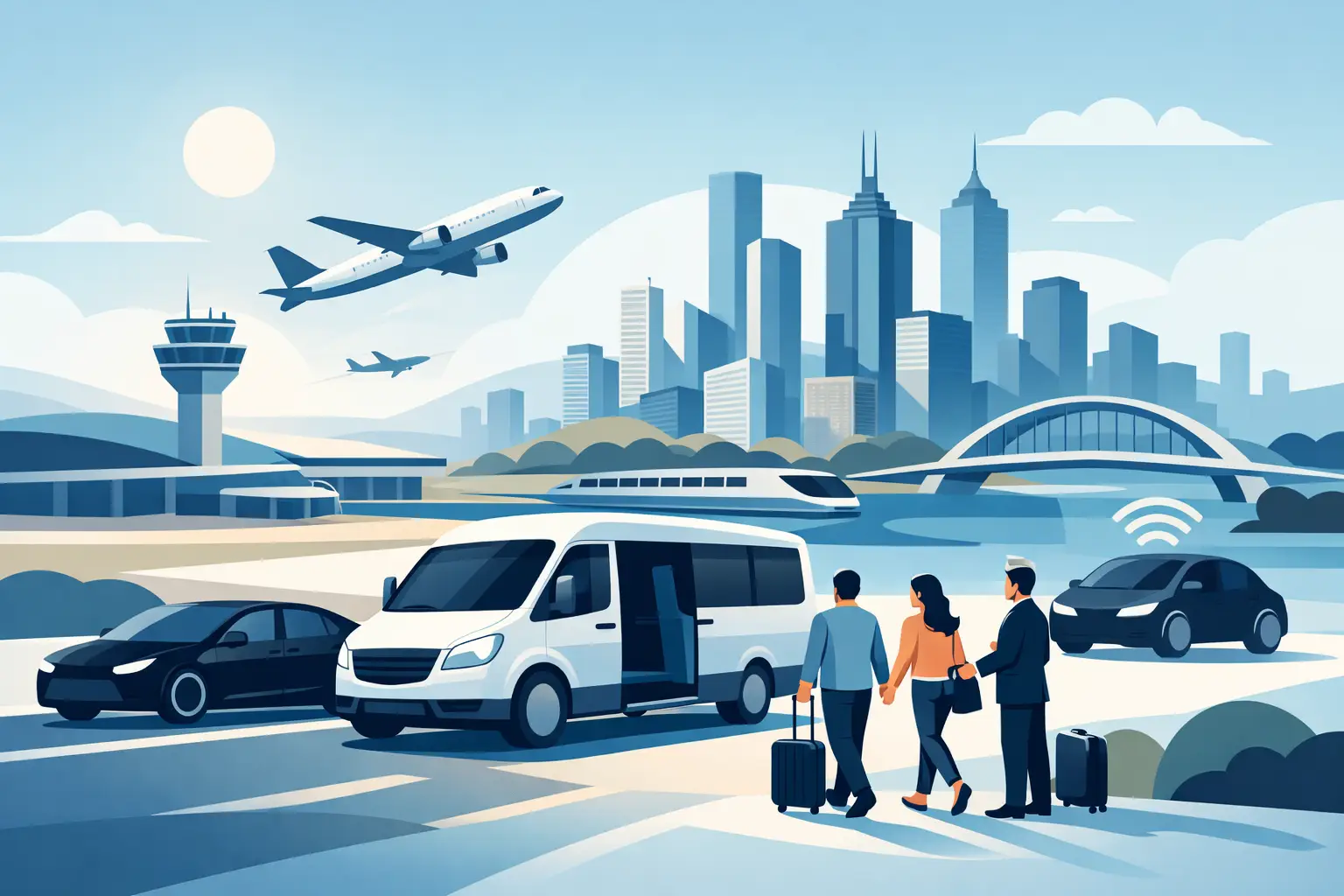
A delayed international arrival at Melbourne Airport can turn a simple pickup into a test of patience. Your mobile may be low on charge, the kerbside busy, and a meeting, family commitment or hotel check-in waiting at the other end. The future of airport transfers will be defined by how well transport providers remove these pressure points before the passenger reaches the arrivals hall.
For executives, families and discerning visitors, getting from the airport is not merely a ride. It is the first or final part of a journey that needs to run to plan. Technology will play a larger role, but the premium standard will remain unmistakably human: a professional chauffeur who is prepared, present and focused on the guest.
The future of airport transfers starts before landing
The best airport transfer is increasingly organised around live information rather than a fixed booking time. Flight monitoring allows a chauffeur service to respond to an early arrival, a delayed departure, a gate change or extended time on the tarmac. Instead of asking a traveller to send updates while they are clearing customs or collecting luggage, the service adapts behind the scenes.
This matters particularly on long-haul arrivals into Melbourne. A scheduled landing time does not account for immigration queues, baggage delivery or the distance between the gate and the pickup point. Future-focused airport transfers will combine flight data with practical local judgement, allowing appropriate time for the arrival process while keeping the vehicle and chauffeur ready when the guest is genuinely able to leave.
Clear communication will be equally valuable. Confirmation details, chauffeur information and meeting instructions should be easy to find on a mobile, without forcing passengers to navigate a chain of messages. For a premium service, that clarity is not an optional extra. It is part of the reassurance that someone has taken ownership of the journey.
Smart technology should make travel feel simpler
Airport transport will become more connected, though not every new feature will improve the passenger experience. The useful innovations are the quiet ones: real-time traffic intelligence, route planning that accounts for roadworks and peak-hour congestion, and booking systems that retain a client’s usual preferences.
A frequent corporate traveller may prefer a discreet executive sedan, a quiet cabin and direct travel to the office. A family arriving after an overnight flight may need child seats, extra boot space and a comfortable SUV. International guests may benefit from a meet-and-greet service, luggage assistance and a chauffeur who can offer calm, local guidance. When these requirements are known in advance, the journey feels considered rather than transactional.
There will also be more integration between flights, hotels, events and ground transport. For corporate travel managers, this could mean better visibility over executive movements and simpler invoicing. For individual travellers, it may mean fewer booking steps and more accurate pickup coordination. The trade-off is data privacy. Premium providers will need to handle traveller information carefully, use it only to improve service and give clients confidence that their movements and preferences are treated with discretion.
Premium service will remain personal
It is easy to assume the future belongs entirely to automation. Self-service kiosks, app alerts and digital payments certainly have a place, particularly for straightforward trips. Yet airport arrivals are rarely straightforward. Flights are disrupted, luggage goes missing, weather changes, and passengers can arrive tired or unfamiliar with the terminal.
That is where a trained chauffeur offers something technology cannot replicate. A courteous greeting at the agreed meeting point, assistance with bags and the confidence of being escorted to a prepared vehicle can immediately lower the stress of travel. For a CEO heading to a board meeting, that time may provide a private space to regroup. For visitors travelling with children or older relatives, it may be the difference between a difficult arrival and a smooth one.
The most successful services will use technology to support their people, not replace them. A chauffeur with live flight visibility, current road conditions and a clear passenger brief is better placed to deliver thoughtful, responsive hospitality. Local knowledge also remains critical. Knowing the most suitable approach to Melbourne Airport, the likely pinch points on the Tullamarine Freeway, or the timing around major city events is practical expertise that no generic map alone can guarantee.
The vehicle becomes part of the travel experience
Expectations for airport vehicles are changing as well. Travellers increasingly want more than a clean car that arrives on time. They expect a quiet, well-presented cabin, reliable climate control, room for luggage and a level of comfort that suits the purpose of the trip.
For one passenger with carry-on luggage, an executive sedan may be the most efficient choice. For a group with several large cases, ski equipment or prams, a premium SUV or people mover is more sensible. Future booking systems should make these choices clearer, helping guests select the right vehicle rather than discovering too late that the boot is insufficient.
Amenities will remain understated but useful. Mobile charging, bottled water where appropriate and clean interiors are small details that signal care. Privacy is often more valuable than novelty. Business travellers need a vehicle that allows a confidential call or a quiet moment before an important engagement, while leisure guests want room to settle in after a flight without feeling rushed.
Sustainability will influence the next generation of transfers
Electric and hybrid vehicles will become a more visible part of premium airport transport across Melbourne and Victoria. They can reduce local emissions and cabin noise, particularly valuable on longer transfers and city journeys. For corporate clients with environmental reporting goals, the availability of lower-emission travel options will become a meaningful consideration.
The transition will not happen at the same pace for every vehicle category or route. A chauffeur provider must balance charging access, vehicle range, luggage capacity and reliability across early-morning and late-night bookings. A vehicle that looks impressive but cannot confidently complete its assigned itinerary is not a premium solution. The practical future is likely to be mixed fleets, where electric, hybrid and efficient conventional vehicles are assigned according to the trip rather than adopted as a one-size-fits-all statement.
Sustainability also extends beyond the engine. Efficient dispatching, reduced empty running, considered routing and vehicles maintained to a high standard all contribute to a more responsible service. Clients should not have to choose between comfort, punctuality and a more considered approach to travel.
Airport access will make planning more valuable
As airports grow, kerbside areas become more controlled. Pickup zones, commercial vehicle requirements and passenger flows can change, especially during busy travel periods. The future of airport transfers will therefore place even greater value on precise meeting arrangements and chauffeurs who understand airport procedures.
For passengers, the ideal process remains straightforward: collect luggage, receive clear instructions, meet the chauffeur and leave without searching through crowded pickup areas. Behind that simplicity is careful planning. A professional service monitors the flight, confirms the meeting point, allows for airport conditions and stays contactable if circumstances change.
This level of coordination also protects valuable time. Corporate travellers do not want to negotiate a fare after landing or wait to see whether a rideshare vehicle accepts the trip. Families do not want to manage tired children while searching for the right car. Transparent, all-inclusive pricing and a confirmed vehicle category provide certainty when it is most needed.
Reliability will be the real luxury
New vehicle technology, smarter booking platforms and sustainable fleets will shape airport travel over the coming years. But the measure of quality will remain simple: did the right vehicle arrive, with the right chauffeur, at the right time, and did the passenger feel looked after from arrival to destination?
For Melbourne travellers, premium airport transport is moving towards a more informed, flexible and individual service. It will anticipate changes without creating extra work for the passenger, offer comfort without unnecessary fuss, and maintain the professional discretion expected on high-stakes journeys.
When arranging your next airport transfer, choose a service that treats the booking as more than a trip from A to B. VIP Cars Australia believes the journey should begin with a prepared chauffeur, a considered vehicle and the confidence that every detail has been managed before you land.


Comments are closed