


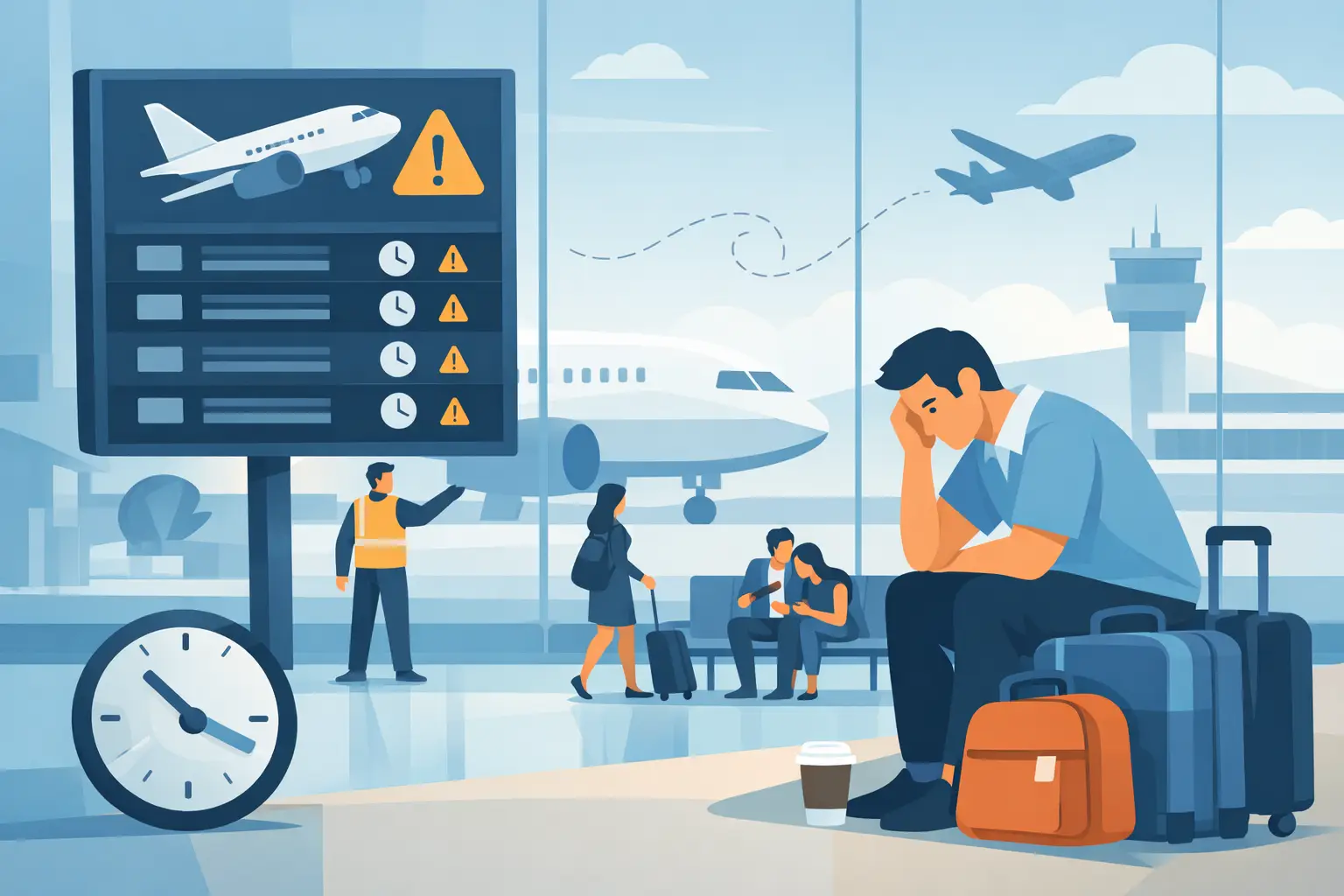
The flight board changes from “on time” to “delayed”, and a carefully planned arrival can suddenly feel uncertain. If you are wondering what happens after a flight delay, the practical answer depends on where the disruption occurs, whether you have a connecting service, and how your onward transport is arranged. For travellers arriving in Melbourne, the difference between a frustrating wait and a controlled arrival often comes down to having clear information and a transport provider prepared to adapt.
A delay does not always mean your entire itinerary has fallen apart. Airlines, airports and professional chauffeur services have systems for changed arrival times. The key is knowing which parts of your journey will move automatically, which require action from you, and why landing time is not necessarily the same as the time you will be ready to leave the terminal.
What happens after a flight delay before departure?
When a flight is delayed before boarding, the airline will usually update the departure screens, its mobile app, gate announcements and, where possible, passenger notifications. The reason may be weather, air traffic restrictions, a late-arriving aircraft, a technical inspection or crew scheduling. Each cause affects the likely duration differently, so a projected departure time can change more than once.
Your first priority is to confirm whether the flight number remains the same and whether the departure gate has changed. This matters for anyone meeting a chauffeur at the other end, as a revised departure time alone does not reliably predict your new arrival time. A delay of 90 minutes at departure can become shorter or longer in the air, depending on routing, congestion and conditions.
If your delay puts a connecting flight at risk, speak with the airline before waiting at the gate. Where flights are on the same booking, the airline will generally manage the connection and offer rebooking options if it becomes unworkable. Separate tickets are more complicated. The next airline may treat a missed flight as a no-show, so contact both carriers as soon as you can.
Keep receipts for reasonable meals, accommodation or transport if the disruption becomes extended. What an airline provides, reimburses or excludes depends on its conditions of carriage, the route, the fare type and the reason for the delay. Ask the airline directly what assistance applies to your booking rather than relying on assumptions or general advice from other passengers.
When the flight is delayed in the air or on arrival
A flight can also lose time after departure. Holding patterns, storms, runway availability and air traffic management may mean the aircraft lands later than scheduled. In this situation, there is usually little for passengers to do beyond keeping their mobile charged and allowing the airline to issue updates.
After touchdown, a delayed arrival still has several stages to complete. The aircraft must reach a gate or remote stand, passengers must disembark, checked baggage must be unloaded and delivered, and international travellers must pass through border processing. At Melbourne Airport, immigration, baggage collection and customs can add meaningful time after an international flight lands, particularly when several wide-body services arrive close together.
For domestic arrivals, the path is normally quicker, but baggage belts, terminal distances and peak-period congestion still matter. If you are travelling with children, sporting equipment, oversized luggage or mobility assistance requirements, build in extra time. A professional airport pickup should be planned around your readiness to depart the terminal, not an unrealistic expectation that you will be at the kerb moments after the wheels touch down.
What happens to your baggage after a delayed flight?
Most checked baggage travels with the aircraft and is delivered to the assigned carousel after arrival. A flight delay alone does not usually change that process, though bags can take longer to appear if ground teams are managing multiple late services or if the aircraft has arrived at a remote stand.
Before leaving the baggage reclaim area, make sure every item has arrived. If a bag is missing, damaged or delayed, report it to the airline’s baggage desk while you are still at the airport. Keep your baggage receipt, boarding pass and the reference number issued for the report. These details are far more useful than trying to reconstruct the issue later from home or a hotel.
For chauffeur coordination, luggage timing is relevant. A driver waiting in the arrivals area can remain ready while you collect bags or complete a baggage report, provided the transport company has your flight details and can communicate with you. This is one reason a meet-and-greet service offers greater control than booking a vehicle only after you emerge from the terminal.
Your onward plans need one clear point of contact
A late flight has a way of creating unnecessary messages: calls to a hotel, a colleague, family members, a restaurant and a driver. Reduce the noise by deciding who needs the revised arrival information immediately. For most travellers, that is the person meeting them or the provider responsible for the next leg of travel.
If you have pre-booked airport transport, send the updated flight details if requested, but do not assume every service tracks flights. Some standard transfers use a fixed collection time. Rideshare availability can also vary sharply during peak arrivals, poor weather or late-night periods, leaving you to manage queues, luggage and pricing after an already long journey.
With a flight-monitored chauffeur booking, the service can respond to the actual progress of your aircraft rather than a timetable that is no longer relevant. VIP Cars Australia monitors incoming flights and coordinates airport pickups around revised arrivals, with a professional chauffeur available to meet you and assist with luggage. That added oversight is particularly valuable when you are heading to a board meeting, connecting to a regional destination or travelling with family after a long-haul flight.
How to handle a delayed Melbourne arrival smoothly
There is no need to refresh the flight board every few minutes. A composed response is more effective, especially when travel has a business or family deadline attached. Use the time before landing or while waiting at the gate to make a few practical checks:
- Confirm your revised flight number, arrival time and terminal through the airline’s official update.
- Notify your chauffeur service, hotel, host or meeting organiser of the change if they are not already tracking the flight.
- Keep your phone charged and turn on mobile access once permitted, so the driver or transport coordinator can reach you.
- Allow for immigration, customs and baggage collection before agreeing to a precise pickup time.
For international arrivals, follow the airport’s instructions and complete any required declarations accurately. A delay can make people feel rushed, but border formalities should never be hurried. Once you enter the public arrivals area, a pre-arranged chauffeur can provide a calm transition from airport procedures to your next destination.
The trade-off between flexibility and certainty
Not every delayed flight requires a premium pickup service. If you are travelling light, have no fixed appointment and are comfortable waiting for public transport or a rideshare, flexibility may suit your plans. However, the calculation changes when time, privacy, presentation or passenger comfort matters.
Executives often need a quiet, well-presented vehicle to make calls or prepare between the airport and the CBD. Families may need appropriate child seating and room for prams and luggage. International visitors may value a driver who knows Melbourne’s roads, hotel entrances and the most sensible route at that time of day. In these situations, certainty is not simply a luxury. It protects the rest of the itinerary from a delay you could not control.
It is also worth checking the terms of any airport transfer before booking. Ask whether the company monitors flights, how it handles early arrivals and significant delays, where the chauffeur will meet you, and how long waiting time is included. Clear answers are a sign of a service designed for real-world travel rather than an arrangement that works only when every flight runs perfectly.
After a flight delay, give yourself room to reset
A late arrival can make even experienced travellers impatient. Rather than carrying that stress into the car, meeting or hotel, treat the transfer as a short reset. Collect your belongings, confirm you have your passport and mobile, and take a moment to check the address of your destination before leaving the terminal.
The best onward travel plan is one that accounts for the realities of aviation: timetables change, terminals take time to exit, and reliable coordination matters most when plans shift. With the right preparation and a chauffeur service that responds to your actual arrival, a delay can remain an inconvenience rather than becoming the defining part of your journey.


Comments are closed